
Views: 0 Author: Site Editor Publish Time: 2026-11-11 Origin: Site


A WP9 torch that starts wandering halfway through a bead, a ceramic cup that cracks on the second tack, a gas lens screen that clogs after a week of stainless work — most shops read these as torch problems. In practice they are almost always tig torch consumables problems, and they are almost always cheaper to fix than the welder assumes.
The small-body 9/20 platform is the most widely used TIG front end in the world and also the one most often mis-stocked. This guide explains how WP9, WP20 and WP25 torches share one consumable family, which part numbers belong to which tungsten diameter, and how to build a tig torch consumables kit that survives a five-day production week.
Match tig torch consumables to the torch platform, not to the brand on the handle: WP9, WP20 and WP25 share one front end.
Size the collet to the tungsten first; the collet body, gas lens and cup all follow from that single dimension.
Treat a tig torch gas lens kit as a matched system — a 45V body paired with the wrong cup loses gas coverage as surely as a worn collet.
Keep tig torch back caps in two lengths, because reach problems are usually solved by a cap change rather than a torch change.
Stock by wear ratio instead of SKU count: collets and nozzles turn over several times faster than back caps.
The model number on a TIG torch describes the head and the cooling method, not a proprietary set of parts. On the 9/20 platform the collet, collet body, gas lens, nozzle and back cap are dimensionally shared across all three torch models, which is why one box of spares can serve an air-cooled bench torch and a water-cooled production torch at the same time.
The WP9 is an air-cooled body rated 125 A on DC and 100 A on AC at a 60% duty cycle, covering tungsten from 0.5 mm to 2.4 mm (0.020 in to 3/32 in). The WP20 is the water-cooled version of the same head geometry at a 250 A class rating; the WP25 is a water-cooled pencil torch with a flexible neck and roughly 200 A of capacity. Different heat loads, identical front end — the most useful single fact for anyone buying wp9 tig torch consumables in bulk.
Attribute | WP9 torch | WP20 torch | WP25 torch |
|---|---|---|---|
Cooling method | Air-cooled | Water-cooled | Water-cooled |
Rated output | 125 A DC / 100 A AC, 60% duty | 250 A class, continuous with water | 200 A class, flexible neck |
Tungsten range | 0.5–2.4 mm (0.020–3/32 in) | 0.5–3.2 mm (0.020–1/8 in) | 0.5–3.2 mm (0.020–1/8 in) |
Front-end parts | 9/20 series | 9/20 series | 9/20 series |
Typical work | Thin sheet, tube, repair | Production welding, heavier sections | Confined access, pipe, aerospace |
A consumable that threads in is not necessarily a consumable that fits. Three interfaces carry the load: the taper between collet body and torch head, which seals the gas path; the taper between collet and collet body, which centres the tungsten and transfers current; and the friction seat where the ceramic grips the body. A supplier can hold the thread and still miss the taper angle, and the result is a joint that feels tight but leaks argon at the back. Fit, not price, accounts for most returns on tig torch consumables.
Failures cluster in three predictable places. Copper alloy hardness in the collet comes first: soft stock deforms under the cap's compression, loses grip on the electrode and lets the arc wander. Concentricity of the collet body taper is second, and it shows up as an arc that holds at low current but drifts as amperage climbs. Ceramic wall consistency is third — thin walls glaze and crack, thick walls foul the lens seat. Those three defects separate durable tig torch consumables from parts that fail inside a week.
The front end is a short chain of five parts, each with a single job. Understanding that chain is what turns a parts list into a diagnosis.
The tig welding torch collet is a split copper alloy sleeve that grips the tungsten; the collet body holds the collet, centres it in the torch head and meters shielding gas through its side ports. When a weld starts fine and then loses focus, check the collet for a polished grip zone before touching machine settings. A worn collet is the lowest-cost part in any set of tig torch consumables and the most expensive one to ignore.
A standard collet body releases gas through side holes and produces a short, turbulent envelope. A gas lens adds a stack of fine mesh screens that straightens the flow into a laminar column, which holds its shape further from the cup. The practical result is longer tungsten stick-out for the same flow, better puddle visibility and far more tolerance for drafts.
Feature | Standard collet body | Gas lens body |
|---|---|---|
Gas flow pattern | Turbulent, short envelope | Laminar, longer column |
Practical stick-out | Up to about one cup diameter | Two to three cup diameters |
Draft tolerance | Low, needs still air | Moderate, suits shop floors |
Cup compatibility | 13N series ceramic cups | 53N series gas lens cups |
Suited to | Simple joints, tight access | Stainless, titanium, thin sheet, pipe roots |
Cleaning routine | Blow out side ports | Inspect and back-flush screens |
The alumina cup forms the shielding envelope and protects the lens from spatter; it does not focus the arc. That is why a larger cup does not make a weld hotter, and why swapping a cup is the right response to porosity on a joint that opens into a cross-draft. Ceramic that has glazed white or shows hairline cracks on the bore should be retired, because a distorted bore disrupts flow more than an oversized cup ever will.
The tig torch back caps compress the collet and seal the rear of the torch. Their length decides how much electrode can sit behind the head, which in turn decides how much tungsten you consume between trims. Short caps suit confined joints; long caps suit deep fixtures and welders who prefer to trim less often.
Back cap | Reference | Preferred use |
|---|---|---|
Short | 41V33 | Confined joints, thin sheet, tight fixtures |
Medium | 41V35 | General fabrication, standard on most torches |
Long | 41V24 | Deep joints, full-length electrodes, fewer trims |
Extra long | 41V24L | Large fixtures with restricted head clearance |
Every tig torch consumables order starts with the electrode diameter, and nearly every ordering error traces back to reading one column of a catalogue as another. The references below follow the numbering used across the welding industry; where a job calls for qualified procedures or welder certification, the published welding standards and qualification guidance are the correct authority to check against.
The collet and collet body must match each other and the tungsten — there is no cross-fitting. A 1.6 mm electrode in a 2.4 mm collet will spin, arc erratically and contaminate the pool with copper.
Tungsten size | Collet | Collet body | Gas lens body | Cup range |
|---|---|---|---|---|
0.5 mm / 0.020 in | 13N20 | 13N25 | 45V41 | 53N58 – 53N59 |
1.0 mm / 0.040 in | 13N21 | 13N26 | 45V42 | 53N58 – 53N60 |
1.6 mm / 1/16 in | 13N22 | 13N27 | 45V43 | 53N59 – 53N61 |
2.0 mm / 5/64 in | 13N22M | 13N27 | 45V43 | 53N60 – 53N61S |
2.4 mm / 3/32 in | 13N23 | 13N28 | 45V44 | 53N60 – 53N87 |
3.2 mm / 1/8 in | 13N24 | 13N29 | 45V45 | 53N61S – 53N87 |
Most tig gas lens kits bundle a 45V series body with a matching cup and collet, which is why the kit reference carries the body number rather than the cup number. A 45V41 kit therefore arrives set up for 0.020 in tungsten and a No. 4 cup; the cup can be exchanged for any 53N size that still fits the body shoulder, but the body itself cannot be re-sized. Because the same body serves a WP9 air-cooled torch and wp 20 tig torch consumables on a water-cooled line, one kit reference covers both.
For high-amperage AC work on aluminium the large-diameter lens family extends beyond the standard range, and 53N87 is the reference usually stocked for the widest shield over a heavy puddle. Keeping that one reference beside 53N58 to 53N61S means a single set of tig torch consumables covers both stainless and aluminium work.
Matching tig torch consumables to a mixed torch fleet?
Send the torch models and tungsten sizes in use, and Forman will return a cross-referenced parts list with cup options and mixed-carton quantities.
Send an Inquiry View Products →
Cup selection trades coverage against access. The number moulded into the ceramic is the orifice diameter in sixteenths of an inch, so a No. 6 cup has a 3/8 in (9.5 mm) bore. It is also the item in the tig torch consumables stack that gets swapped most often, which makes cup size the fastest adjustment a welder can make mid-job.
Cup | Orifice | Standard cup | Gas lens cup | Working current |
|---|---|---|---|---|
No. 4 | 1/4 in (6.4 mm) | 13N08 | 53N58 | Up to about 80 A |
No. 5 | 5/16 in (7.9 mm) | 13N09 | 53N59 | 40–110 A |
No. 6 | 3/8 in (9.5 mm) | 13N10 | 53N60 | 60–150 A |
No. 7 | 7/16 in (11.1 mm) | 13N11 | 53N61 | 100–200 A |
No. 8 | 1/2 in (12.7 mm) | 13N12 | 53N61S | 150–250 A |
No. 10 | 5/8 in (15.9 mm) | 13N13 | — | 200–300 A |
No. 12 | 3/4 in (19.0 mm) | — | 53N87 | 250 A and above |
Step up one size when porosity appears on a joint open to air movement, or when the tungsten is long enough that the envelope breaks down. Step down when the cup is bridging on a fillet, or when arc visibility rather than gas coverage limits the weld. On titanium and thin stainless a gas lens with a No. 6 or No. 7 cup usually outperforms a standard body with a No. 8, because laminar flow protects a longer exposed electrode.
A useful tig torch consumables kit is not a random assortment in a compartment box. It is a small inventory built around the tungsten sizes a shop actually runs, with spare multiples that reflect wear rates rather than nominal quantities.
The reference kit below covers one WP9, one WP20 and one WP25 with two common electrode sizes in daily use, on a five-day production week.
Item | Qty per kit | Reorder trigger |
|---|---|---|
Collets, both sizes | 20 (10 each) | Fewer than 6 of a size |
Collet bodies | 6 (3 each) | Fewer than 2 of a size |
Gas lens bodies | 4 | Screen discoloured or flow uneven |
Alumina cups, mixed No. 5–No. 8 | 20 | Fewer than 3 of any size |
Back caps, short and medium | 4 | Threads stiff or seal damaged |
Cup gaskets and insulators | 10 | Any hardening visible |
Collets and cups carry the thermal load and the mechanical abuse; lens bodies and back caps mostly carry neither. On a fabrication bench, ceramics and collets turn over several times faster than lens bodies, and back caps are replaced on damage rather than wear. That ratio, not the catalogue price, should decide which tig torch consumables you overstock — and it is why a tig welding consumables kit priced per piece often costs more over a year than a properly sized mixed carton.
Most symptoms blamed on the machine trace back to one of five consumable faults. The matrix below is the sequence worth checking before any parameter is changed, and it applies equally to wp 20 tig torch consumables and to wp 25 tig torch consumables because the front end is identical.
Symptom | Likely cause | Countermeasure |
|---|---|---|
Porosity at arc start | Loose cup seat or damaged gasket | Reseat cup, replace gasket, re-check flow |
Arc wander at higher current | Worn collet or off-centre body | Replace collet, inspect body taper |
Tungsten discolours quickly | Gas leaking at back cap thread | Swap cap, check rear seal |
Ceramic cracks on second tack | Cup over-tightened or wall too thin | Hand-seat only, use consistent wall stock |
Coverage fades over a shift | Spatter blocking lens screens | Back-flush screens, replace if flow uneven |
A sixth case deserves its own line: a torch that welds cleanly at 60 A and misbehaves at 140 A usually has a collet body that is not seating squarely in the head. Heat expands the joint, the taper loses contact and the gas path opens. A straight-edge check against the head face will identify it in under a minute; no amount of electrode trimming will.
One caution applies to every fix above: shielding gas protects the pool, not the operator. Argon displaces oxygen in confined spaces, and welding fume is a separate exposure route, so the ventilation requirements in federal guidance on welding, cutting and brazing and the exposure research summarised in public health studies of welding fume matter as much as torch maintenance.
Consumables are a volume purchase, and the difference between suppliers shows up later than the invoice. Three checks separate a dependable source from a cheap one: documented dimensions on the taper and thread rather than “fits WP9” claims; consistent copper alloy hardness across lots; and ceramic wall thickness held within tolerance so that a carton of cups does not arrive half-cracked. The same checks apply whether the order is one collet body or a full carton of wp 9 tig torch parts.
Ask for a dimensional drawing of the collet body taper, not a photo of the part.
Request samples across two tungsten sizes so collet grip can be judged under load.
Confirm the supplier can ship tig torch consumables in the same carton as plasma parts, which cuts freight on mixed orders.
The four products below cover the parts that wear fastest on a 9/20 platform; they can be ordered as single references or consolidated with other torch models.

45V41 TIG Gas Lens Kit for WP9
Complete gas lens front end for 0.020 in tungsten, with 45V42 to 45V44 covering 1.0 mm to 2.4 mm electrodes in the same tig torch consumables range.
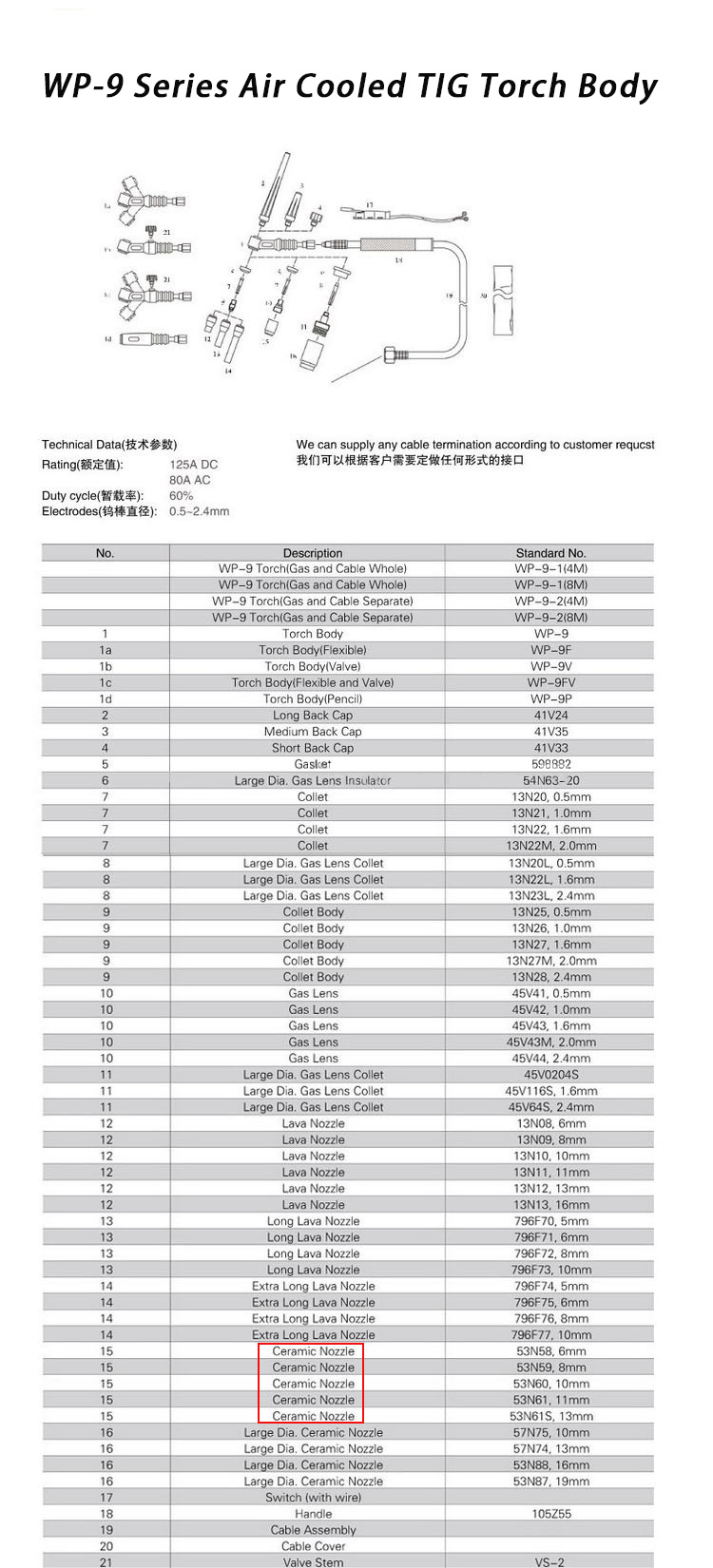
53N58 Alumina Nozzle Kit
Gas lens cups No. 4 to No. 8, 25.5 mm long, in high-purity alumina for WP9, WP20 and WP25 torches.
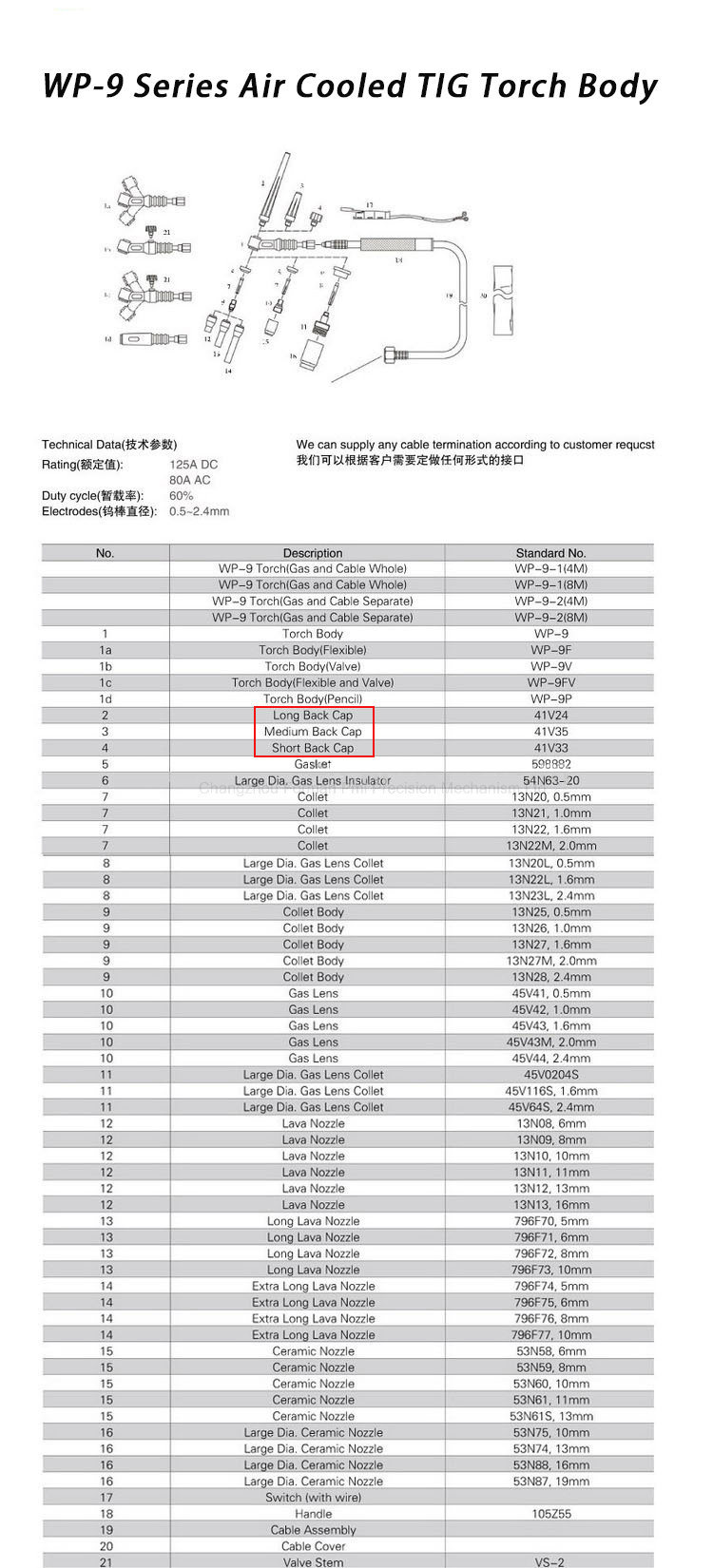
Back Caps, WP9 / WP20 / WP25
References 41V33, 41V35 and 41V24 in short, medium and long lengths for reach and electrode consumption.
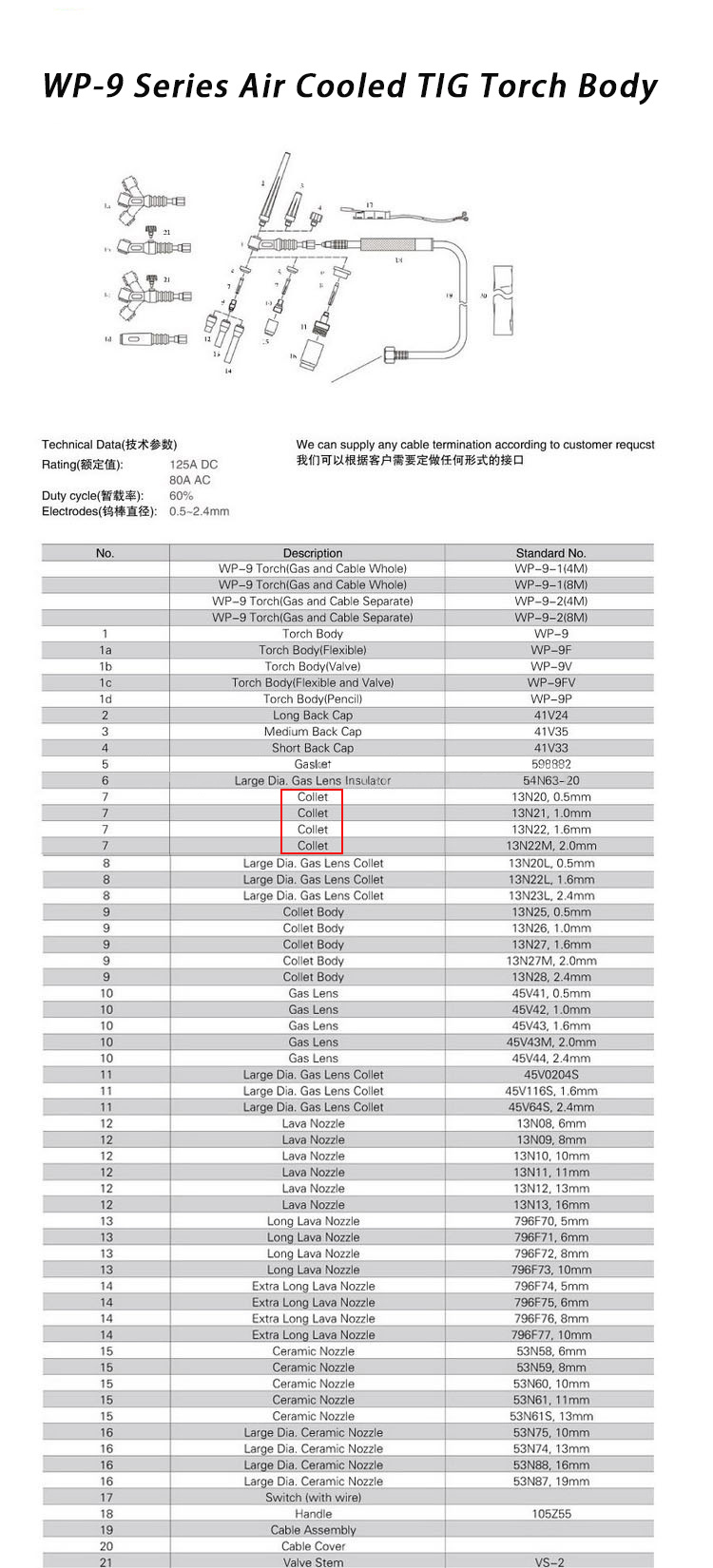
Collets, 13N21 to 13N23
Ten-piece packs covering 1.0 mm to 2.4 mm electrodes, sized to match 13N series collet bodies.
Torch problems that repeat on schedule are usually consumable problems on schedule. Once the 9/20 front end is read as one system — collet sized to tungsten, collet body sized to collet, cup sized to current and access, back cap sized to reach — the guesswork leaves selection, and one set of tig torch consumables serves a WP9 bench torch, a WP20 production torch and a WP25 pencil torch without duplication.
If you are looking for a reliable tig torch consumables manufacturer, choose Forman. Changzhou Forman Welding Equipment Co., Ltd supplies wp9 tig torch consumables, wp 20 tig torch consumables, wp 25 tig torch consumables and plasma cutting parts from one facility, with dimensional inspection, mixed-carton packing and export documentation for distributor and OEM orders.
Amperage ratings, tungsten ranges and cup dimensions above are typical published values compiled from manufacturer catalogues and may vary by torch body, cable length and duty cycle. Confirm part references against your own torch before a production order.
Ready to consolidate your TIG spares into one shipment?
Share your part references and annual quantities for a quotation covering collets, collet bodies, gas lens kits, nozzles and back caps.
Get a Quote Explore TIG Parts →
Do WP9, WP20 and WP25 torches really use the same tig torch consumables?
Yes. All three sit on the 9/20 platform and share the collet, collet body, gas lens body, nozzle and back cap. The difference between them is the head and the cooling method, so one set of spares covers an air-cooled WP9 and a water-cooled WP20 or WP25.
Which collet do I order for a 1.6 mm tungsten?
A 1.6 mm (1/16 in) electrode needs a 13N22 collet with a 13N27 collet body, or a 45V43 gas lens body if the torch runs a lens. Matching the collet to the electrode diameter is the first decision in every tig torch consumables order.
Are tig gas lens kits worth the extra cost?
For stainless, titanium, thin sheet and pipe roots, usually yes. Laminar flow allows longer tungsten stick-out and better puddle visibility, which reduces contamination and rework. For simple joints at low current in still air, a standard collet body and 13N cup remain the sensible centre of a tig torch consumables set.
Can the 53N87 cup run at 250 A on a WP20?
That cup is intended for heavy puddles at high current, and it pairs with a large-diameter gas lens body rather than a standard 45V body. Confirm the body shoulder diameter before pairing, because a wide cup on an undersized body will not seat — one of the most common fitting complaints on tig torch consumables.
Why do tig torch back caps come in different lengths?
Length sets how much electrode can sit behind the head. Short caps fit confined joints and thin sheet, medium caps are standard on most torches, and long or extra-long caps suit deep fixtures and welders who trim tungsten less often.
How often should ceramic nozzles be replaced?
Replace any cup with cracks, white glazing or an oval bore as soon as it is found, and inspect at the start of each shift. Cups are the least predictable item in any set of tig torch consumables, so two spare sizes on the bench avoid a stalled job.


